
Software and systems
LPFS purlin parallel file system
A high-performance parallel file system based on software-defined storage technology, unified namespace, and standard POSIX interface.

corecharacteristic
Parallel Architecture Design
Based on multi-node metadata layout and data sharding, it supports parallel access by multiple clients, breaks the single-point performance bottleneck of traditional file systems, scales near-linearly with nodes, and eliminates single points of failure.
High-Performance I/O Optimization
Multi-path data distribution, intelligent caching and RDMA network acceleration significantly improve small-file read/write efficiency and sustained large-file throughput, ideal for AI training and scientific computing workloads.
High Reliability & Fault Tolerance
Multi-replica (EC) and checksum protection with automatic failure detection and rapid data rebuild deliver 99.999% system reliability and ensure business continuity.
Cross-Platform Compatibility
Compatible with mainstream operating systems (Linux/Windows), supports standard POSIX plus NFS, SMB, HDFS and S3 protocols, and offers Kubernetes CSI integration for seamless public, private and hybrid cloud architectures.
Product details
LPFS (LinePillar FS), independently developed by LUISUAN Technology, is an enterprise-grade storage solution for high-performance computing (HPC), artificial intelligence (AI) and big data analytics. With optimized data access, higher efficiency and easy scalability as its core design goals, it supports massive data storage and highly concurrent access, featuring high throughput, low latency and easy scaling.
System Architecture
Built on software-defined storage (SDS) technology, LPFS provides a unified namespace and standard POSIX file interface. The architecture is layered top-down into the application protocol layer, data processing layer and hardware node layer:
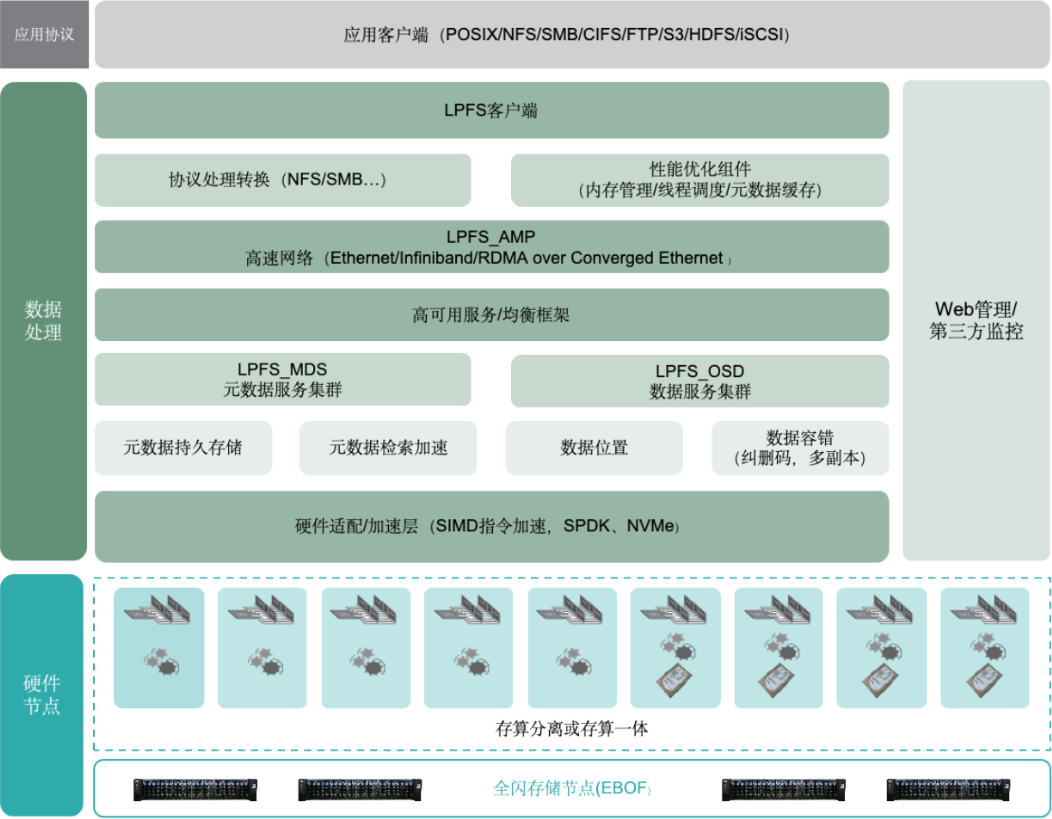
How it works: the LPFS client connects through protocol conversion and performance optimization components, and reaches the metadata service cluster (LPFS_MDS) and data service cluster (LPFS_OSD) over the LPFS_AMP high-speed network. High-availability services and the load balancing framework ensure business continuity, while the hardware adaptation/acceleration layer (SIMD, SPDK, NVMe) fully unleashes all-flash performance. Hardware nodes support either disaggregated or converged compute-storage deployment.
Application Scenarios
Designed for HPC, AI training and inference, big data analytics and massive unstructured data storage scenarios, LPFS delivers a high-concurrency, high-bandwidth unified storage foundation.